
Solar vs. EV Tariffs: Where should your energy go?
☕ Help keep Solar Sid independent
Hi, I'm Dale McWilliams (Solar Sid). This site has no ads and no installer sponsors — it's 100% independent. If the guides helped you, you can buy me a coffee to help cover domain and hosting and keep it free for everyone.
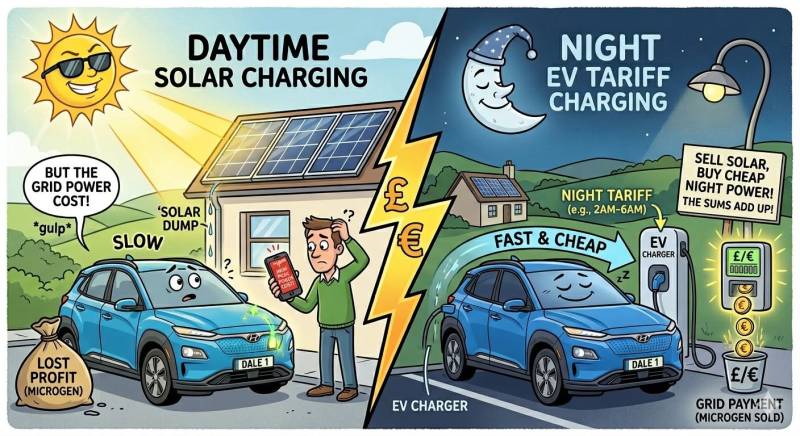
I see a lot of people debating whether to burn their precious solar on their EV or hold out for a cheap nighttime EV tariff. It's a great question, but the “best” answer usually comes down to the sums. Here's a breakdown of why, for most of us, selling your solar and charging at night is the winner.
Why the "Night Owl" (EV Tariff) usually wins:
The Price Gap: In most cases, your cheap nighttime rate is significantly lower than what you could be getting paid for exporting your solar (the Microgeneration support). It's essentially a free pass to stick it to the man while you sleep.
Guaranteed Savings: Solar production in Ireland is about as reliable as a chocolate teapot—guaranteed to let you down just as you're turning on the kettle. An EV tariff gives you a guaranteed, rock-bottom price every single night, rain or shine.
The Battery Buffer: Charging at night allows you to also keep your home battery topped up with solar during the day to cover your evening peak usage—which is usually much more expensive than the electricity you'd buy at night. Plus, leaving a buffer in your battery helps you absorb “clipping” during peak solar production (when your inverter hits its limit), and gives you the flexibility to dump that excess energy into the grid or your car as and when it's most beneficial.
Why "Daytime Charging" isn't always the dream:
The “Double Loss”: If you're charging your car off the grid during the day, you're paying full price while the sun is just mocking you. Even if you have solar, you're often “netting out” at a loss because you aren't exporting that high-value solar energy for credit. It's like buying a pint and then pouring half of it down the sink.
Opportunity Cost: Every kWh of solar you put into your car during the day is a kWh you aren't selling to the grid or using to keep your house from going into full panic mode when the sun goes down.
Efficiency: Most home solar setups can't actually charge an EV at full speed. Relying on “excess” solar often means the car sits in the driveway for hours at a very slow charge rate, which is about as efficient as waiting for a bus that never comes, compared to a fast, cheap 3 or 4 hour charge window at night.
The Golden Rules
If you have solar, your priority should be:
  1. **Use it for your home** (keep the house running).
  2. **Sell it to the grid** (get paid for every exported kWh).
  3. **Buy cheap at night** (use the massive price difference to your advantage).
Bottom line: Unless you have massive, massive excess solar that you literally have no other use for, you are usually better off selling your solar for credit and filling your car when the grid is at its cheapest.
☕ Solar Sid's Tip: Not sure? Run both scenarios in my Irish Solar Calculator — test “Charge EV from Solar” vs “Charge EV at night on EV tariff” and see the euro difference for your MPRN.